


When AI Accelerates Development, What Do You Need from an Engineering Partner?.
AI-assisted development can change the support your team needs. Define who owns implementation, integration, verification and handover before comparing engineering partners. Use four possible assignments and five briefing questions to turn a working prototype into a clear sourcing need.


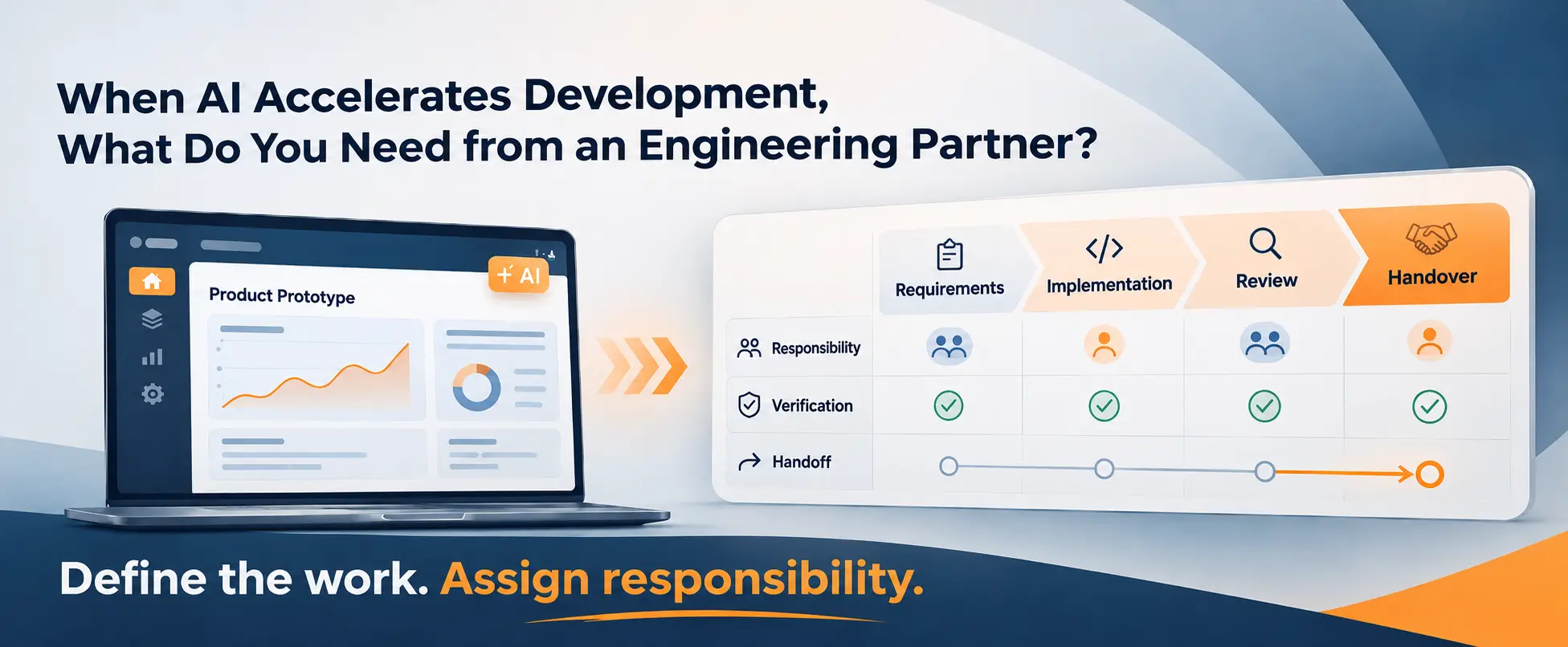
Your team has built a prototype with AI assistance. The main workflows work, and the business can see its potential. Now it needs to connect to existing systems, handle real data and run reliably.
What should an external engineering partner contribute at this point?
You may need developers for defined tasks, a partner to take responsibility for an integration, or specialists to assess what your team has already built.
As more implementation becomes possible internally, it is worth revisiting the external support you need. Start by identifying what your team can deliver and verify, and where it needs additional expertise.
Start with the work your team will own
Describe the intended result before choosing a delivery model. What must the application do? Under which conditions must it work? What has already been tested, and what remains an assumption? See ValueLeap’s partner selection criteria for the broader decision framework.
Then establish what your team can realistically own. That includes requirements, technical decisions, reviews, acceptance and ongoing operation. Keeping a task internally requires someone with both the competence and the time to carry it through.
AI assistance may change who does the implementation. Decisions, verification and release still need named owners.
The same prototype, four possible partner assignments
Consider a hypothetical internal application for handling service requests. A small team has built the workflow with AI assistance. CRM integration, permissions, error handling and operational support still need attention.
The external assignment could take several forms:
- Additional implementation capacity. Your team defines requirements, architecture and acceptance criteria. The partner completes specified tasks within those boundaries.
- Responsibility for a defined component. The partner designs, implements and verifies the CRM integration, with agreed interfaces and customer dependencies.
- Responsibility for the agreed delivery. The partner helps resolve outstanding requirements and owns implementation and verification through to handover. Customer decisions and acceptance remain with the people assigned to them.
- Specialist services and independent assessment. Your team or an existing partner leads development. Other specialists address data quality, perform a security review or assess defined aspects before release.
These assignments can be combined. Labels such as Staff Augmentation, Dedicated Team or Project Delivery become useful once the actual work and responsibilities are clear.
When the need shifts towards data, security and verification
If your team can implement more itself, external expertise may become particularly valuable in areas it cannot confidently assess.
Data is one example. Which sources are reliable? Are records complete and current? Who owns data quality and access? DORA’s research on healthy data ecosystems identifies high-quality, accessible and unified internal data as a capability that strengthens the positive effects of AI adoption. For a buyer, the practical question is which data tasks the internal team can cover and where specialist support would help.
Security also requires a clear distinction between software developed with AI assistance and software that contains AI functionality. Both need appropriate application security checks. A product containing an AI model introduces further questions about model behaviour, data disclosure and responses to manipulated inputs. NIST’s Generative AI Profile (PDF) describes AI red teaming as one way to investigate adverse behaviour and test safeguards.
For a practical provider perspective, Apriorit discusses adversarial testing and other controls in its article on secure AI chatbots, available through Apriorit’s Partner Insight on secure AI chatbots.
Select the assessment to match the system and its risks. A security review, penetration test and AI red-team exercise answer different questions.
Where confidence in the implementation is still developing, competent external specialists can provide an independent assessment. Independence should be part of the assignment: consider their involvement in the implementation, potential conflicts of interest and who receives their findings. Give them access to the information needed to reach a useful conclusion.
Agree what will be examined, what evidence will be delivered and how findings will be resolved and retested. The assessment informs the decision; responsibility for accepting the delivery or approving release must also be assigned.
Five questions for your partner brief
1. Which decisions should the partner prepare or make?
Should the partner implement specified tasks, or also challenge requirements, evaluate options and propose an architecture? Identify who decides and which approvals are needed.
2. What results will the partner own, and what will it depend on?
Name the deliverables and dependencies. Who supplies test data, provides system access and resolves questions with the CRM owner? Give each interface an owner and agree how unresolved issues will be handled.
3. How will you establish that the result meets your requirements?
Set acceptance criteria and define the evidence you expect. For the service application, this might cover invalid data, permissions and behaviour during a CRM outage. Decide which aspects need independent assessment, who resolves findings and who approves any remaining risks.
4. How will AI be used and its outputs checked?
Ask which tasks AI supports, how results are reviewed and what rules govern company data. A useful answer describes the workflow and the people responsible for it. Distinguish AI used during development from AI functionality in the delivered product.
5. What must your organisation retain after handover?
Establish who will operate, maintain and extend the application. Agree access, documentation, knowledge transfer and any continuing support. Include the possibility that the partner leaves completely after the agreed handover.
Match the evidence to the partner’s responsibilities
Different responsibilities call for different evidence. For an integration assignment, look for projects with comparable system dependencies and a clear account of the provider’s role. For an independent review, examine the proposed team’s assessment experience, methods and independence from implementation.
A certification can support questions about organisational processes within its scope. Project-specific findings address the implementation examined. Ask how the evidence relates to your requirements and to the people proposed for your engagement.
When comparing offers, make assumptions visible. If AI is expected to reduce implementation effort, which tasks become smaller? What remains for architecture, data preparation, integration, verification and handover? Are specialist assessments included, and what contribution is expected from your team?
Comparable scope and responsibilities make differences in price and effort easier to judge.
Write the brief before comparing partners
Capture the assignment in a short paragraph:
“We want to achieve … . Our team will own … . The partner will be responsible for … . We will verify the result through … . Where needed, an independent assessment will cover … . After handover, our organisation must retain … .”
Any gaps identify work to do before requesting proposals. Completing the brief helps you choose the expertise, responsibility and evidence your project needs.
ValueLeap helps technology leaders define that sourcing need, assess suitable partners and access software engineering services through its contracted partner network.
