


How AI-Native Engineering Changes What Tech Buyers Need from Software Engineering Partners.
As Tech Buyers build AI-native engineering systems, external software-services demand may shift from generic execution capacity toward specialised capabilities, integration, verification and clearly defined responsibility.


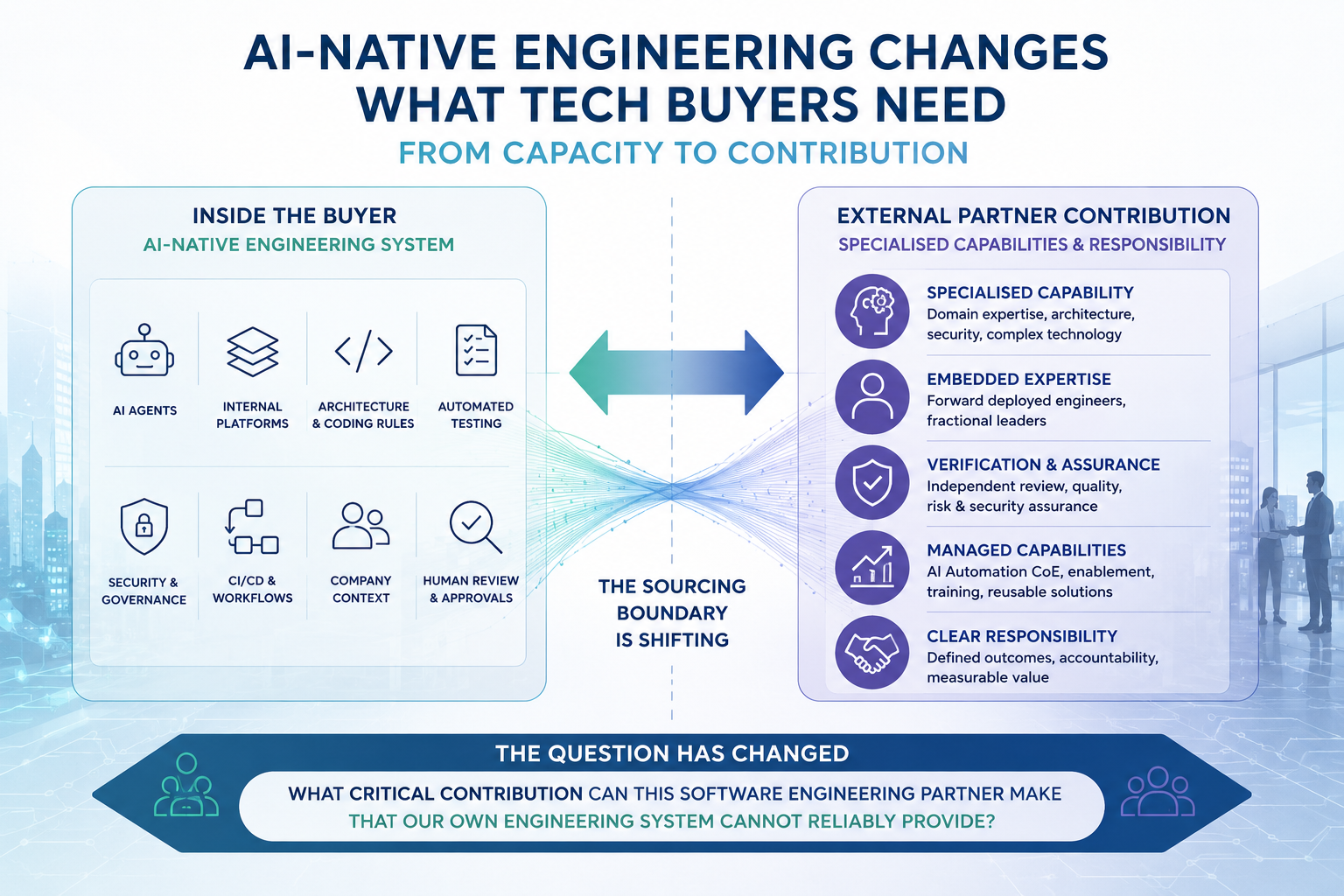
AI-native engineering is changing more than developer productivity.
As companies integrate AI agents, internal platforms, automated testing, architecture rules, security controls and company-specific context into their engineering environments, they can increasingly orchestrate software development themselves.
That changes the sourcing question.
For Tech Buyers, Software Engineering Partner Selection may become less about finding additional execution capacity and more about deciding which capabilities, expertise, assurance and responsibility still need to come from outside the organization.
The result is unlikely to be a simple decline in external software services. A more plausible shift is a change in the volume, mix and value proposition of external demand.
What do we mean by AI-native engineering?
In this Insight, AI-native engineering means an engineering environment in which AI agents and automation are integrated into the way software is designed, built, tested, reviewed and operated.
This can include:
- coding and software-development agents,
- internal developer platforms,
- company-specific repository and documentation context,
- architecture and coding rules,
- automated testing and quality gates,
- security policies,
- CI/CD workflows,
- human review and approval mechanisms.
This is different from simply giving individual developers an AI coding assistant.
The 2025 DORA research describes AI as an amplifier of the underlying engineering system: organizations with strong platforms, processes and feedback loops are better positioned to translate AI adoption into useful outcomes, while weak systems can have their problems amplified as well.
GitHub is moving in a similar direction at product level, positioning agents as part of an orchestrated development environment with code review, enterprise controls and governance rather than as isolated developer tools.
For a Tech Buyer, that matters because the organization itself can increasingly own more of the engineering production system.
The sourcing boundary starts to move
Traditionally, an external Software Engineering Partner could bring a relatively complete delivery setup:
- people,
- engineering process,
- tools,
- project management,
- architecture practices,
- quality assurance,
- delivery governance.
The Buyer might define the requirement and then rely heavily on the Software Engineering Partner to organize execution.
In an AI-native environment, more of that orchestration can remain inside the Buyer organization.
Internal teams can use AI to perform or coordinate a broader range of development tasks. AI usage is also spreading across occupational categories beyond software engineering, although adoption remains highly uneven. Anthropic's Economic Index research shows both the particularly strong use of AI for software-development work and substantial usage across areas such as business, administration, education and media.
That does not mean business users suddenly replace professional software engineering.
It does suggest that some smaller automations, internal tools, analysis tasks, prototypes and workflow improvements can move closer to the people who understand the business problem.
The sourcing question therefore moves one level up:
What should we build and orchestrate ourselves, and where do we still need external capability?
Generic execution capacity may become a weaker standalone proposition
Additional engineering capacity will not disappear.
Complex products still need people. Large transformations still require execution. Internal teams will continue to face capacity constraints.
But if AI enables an existing engineering team to accomplish more, the ability to provide additional developers can become a weaker standalone differentiator.
The productivity effect should not be overstated. Research still shows substantial variation by context. METR's early-2025 controlled study found that experienced open-source developers working on their own repositories took longer to complete tasks when using the AI tools available at the time. METR explicitly cautioned against generalizing that result to software development as a whole. In a 2026 follow-up, METR said it was likely that developers were receiving more acceleration from newer AI tools, while also noting that wider AI adoption and changes in developer behaviour had made the productivity effect increasingly difficult to measure reliably.
For Tech Buyers, the relevant implication is therefore not:
AI makes external developers unnecessary.
It is:
If our own engineering system can execute more efficiently, what additional value must an external Software Engineering Partner contribute?
That contribution may increasingly need to be more specific than capacity alone.
The external demand mix can shift toward harder-to-reproduce capabilities
As more execution can be supported internally, capabilities that are difficult to automate, acquire quickly or develop from first principles may become relatively more valuable.
Examples include:
- deep domain expertise,
- complex software and platform architecture,
- security and regulatory expertise,
- difficult integration work,
- legacy-system understanding,
- specialised technology knowledge,
- independent technical verification,
- quality and risk assurance,
- ownership of clearly defined delivery responsibility.
This does not mean AI cannot assist with these areas. It means the Tech Buyer may still need judgement, experience, accountability and contextual expertise that cannot simply be created by adding another agent to the internal toolchain.
This changes how capability fit should be evaluated.
The question is no longer only:
Can this Software Engineering Partner perform the work?
It increasingly becomes:
What does this Software Engineering Partner add that our own engineering system cannot reliably provide?
New forms of external support may grow alongside reduced capacity demand
A shift away from generic capacity does not necessarily mean a shift away from external support.
It can create new types of sourcing needs.
One emerging example is the Forward Deployed Engineer: a senior technical role embedded closely with the customer, combining discovery, architecture, implementation and production rollout. OpenAI currently describes its FDE role as owning work from technical discovery and system design through build and production deployment alongside customer engineering and domain teams.
Anthropic and DXC are also explicitly building a Forward Deployed Engineer model for enterprise AI adoption, with engineers embedded in customer organizations.
For Tech Buyers, the broader pattern is more important than the job title.
Instead of sourcing a large external team, an organization may sometimes need:
- one or several highly specialised embedded engineers,
- fractional technical leadership,
- fractional architecture capability,
- AI transformation expertise,
- temporary technical governance,
- specialist support during a transition.
These roles can complement an internal engineering system rather than replace it.
They deserve separate analysis because their selection criteria, responsibility and commercial model differ substantially from traditional team extension.
Some Buyers may externalize an AI Automation capability instead of individual projects
Another possible sourcing model is an external AI Automation Center of Excellence or similar managed capability.
The logic is different from outsourcing one large application.
A specialised Software Engineering Partner could support a portfolio of smaller AI and automation initiatives across the organization by providing:
- reusable architectures and patterns,
- AI and agent expertise,
- security and governance frameworks,
- implementation capacity,
- evaluation practices,
- enablement and training,
- advice on which use cases are worth pursuing.
This model is still emerging, so it should not be treated as a standard market category.
But the underlying demand is visible: service firms and AI providers are already building dedicated AI deployment practices, Forward Deployed Engineering teams and Centers of Excellence aimed at moving enterprise AI from experiments into production. Anthropic and Accenture, for example, announced a dedicated Claude Center of Excellence alongside field-deployment capabilities.
For smaller and mid-sized organizations in particular, it may be inefficient to build every specialist AI capability permanently in-house.
That creates a different sourcing decision:
Which AI capabilities should become part of our permanent engineering system, and which are better consumed as an external managed capability?
The Software Engineering Partner increasingly needs to fit the Buyer's engineering system
When the Buyer owns more of the engineering environment, Partner Selection needs to assess integration differently.
It is no longer enough to ask whether the Software Engineering Partner has its own good engineering process.
Tech Buyers may need to ask:
- Can the Software Engineering Partner work inside our repositories and engineering standards?
- Can it use our AI tools and agent workflows?
- Can it operate within our architecture rules and quality gates?
- How does it work with our internal platforms and CI/CD?
- What company context does it require?
- What data, code and intellectual property would its AI tooling access?
- How are AI-generated changes reviewed?
- Which decisions remain human-owned?
- Can the Software Engineering Partner contribute reusable knowledge back into our engineering system?
This makes engineering-system fit a relevant dimension of Software Engineering Partner Selection.
It also makes governance more important.
GitHub's current agentic-security guidance emphasizes permissions, context boundaries and human accountability as agent autonomy increases. Its code-review guidance similarly keeps human ownership of the final merge decision even as AI performs more review work.
The Buyer therefore needs to evaluate not only how much a Software Engineering Partner can automate, but also how safely and transparently that automation fits into the organization's controls.
More output increases the importance of verification
AI can make code generation and change execution faster. That does not automatically mean the resulting software is better.
DORA's research reinforces the importance of testing, feedback loops, governance and strong delivery practices as AI adoption increases.
This creates another possible shift in external Partner value.
A Software Engineering Partner may increasingly add value not only by producing software but also by:
- validating architecture,
- reviewing AI-generated changes,
- testing complex systems,
- identifying risks,
- challenging internal assumptions,
- providing specialised security review,
- giving an independent technical perspective.
For the Tech Buyer, the selection question becomes:
Can this Software Engineering Partner increase our confidence as well as our output?
That is a different value proposition from simply adding capacity.
The commercial model may need to follow the change in value
AI also challenges how Software Engineering Partners are bought.
Time and Materials will not disappear. It remains appropriate where scope is uncertain, collaboration is continuous or the Buyer intentionally wants flexible access to capability.
But if AI significantly reduces the effort required for certain types of work, effort becomes a less reliable proxy for value.
Tech Buyers may increasingly consider commercial models based on:
- a defined deliverable,
- a defined transformation,
- a clearly bounded responsibility,
- a reusable solution adapted to the Buyer,
- measurable operational outcomes,
- specialised capability delivered for a specific purpose.
Fixed Price and outcome-oriented models are not the same thing. A fixed price can still simply package estimated effort. An outcome-oriented model starts with the contribution or result the Buyer is actually purchasing.
This distinction is likely to become increasingly relevant where Software Engineering Partners use AI to compress execution effort.
It deserves its own deeper ValueLeap Insight.
AI can also change which projects are economically viable
The effect is not limited to new development.
Application Modernization is a good example.
Historically, a significant part of modernization cost came from understanding large legacy estates, documenting behaviour, identifying dependencies, rewriting code and validating that the transformed system still worked correctly.
AI-assisted tools are increasingly targeting exactly these tasks. AWS, for example, now offers agentic tooling for repeatable code and application transformations, while Google Cloud is applying generative AI to mainframe assessment, transformation and testing.
That does not make modernization trivial.
It can, however, change the economics sufficiently that Tech Buyers should revisit projects that were previously considered too expensive, too slow or too difficult.
The sourcing requirement then also changes.
The most valuable Software Engineering Partner may no longer be the company capable of supplying the largest migration team. It may be the Partner that combines:
- strong modernization architecture,
- legacy-system understanding,
- AI-enabled transformation capability,
- testing and verification,
- responsibility for a controlled transition.
Again, the selection shifts from capacity toward contribution.
What changes in Software Engineering Partner Selection?
For an AI-native Tech Buyer, a traditional capability and delivery assessment remains relevant.
But it may no longer be sufficient.
Seven additional questions become increasingly useful:
1. What critical capability does the Software Engineering Partner add?
Is the contribution difficult to reproduce internally, or are we primarily purchasing additional execution capacity?
2. How well does the Software Engineering Partner fit our engineering system?
Can it work within our repositories, platforms, AI workflows, standards and controls?
3. What context does the Software Engineering Partner contribute?
Does it bring domain knowledge, architectural experience, specialised technology knowledge or lessons from comparable situations?
4. How does it improve verification and confidence?
Can it help validate AI-assisted delivery rather than simply generate more output?
5. What responsibility can it genuinely own?
Is the Partner providing people, specialised capability, a defined deliverable or responsibility for an outcome?
6. How does its AI-enabled delivery remain governable?
Are security, permissions, context boundaries, human review and accountability clear?
7. Does the commercial model reflect the contribution?
Are we paying for effort because effort is genuinely what we need, or because that is simply how software services have traditionally been purchased?
These questions do not replace existing Partner Evaluation.
They change its centre of gravity.
Questions Tech Buyers often ask.
Will AI-native engineering reduce the need for external Software Engineering Partners?
It can reduce demand for some forms of external execution capacity, but it can also create new sourcing needs. The more relevant question is how the mix changes between internal execution, specialised external capabilities, embedded experts, managed AI capabilities and clearly defined external responsibility. Current productivity research does not support a single universal reduction factor.
Will Tech Buyers still need external developers?
Yes, in many situations. Capacity constraints, complex transformations, specialised technology requirements and major product initiatives will continue to require engineering effort. The difference is that generic capacity may become less differentiating where the Buyer can orchestrate more execution through its own AI-native engineering system.
What kinds of external roles may become more relevant?
Highly specialised and embedded roles may become more important in some sourcing situations. These can include Forward Deployed Engineers, fractional technical leadership, specialised architects, AI experts and independent technical reviewers. The appropriate model depends on the Buyer's sourcing need and internal capabilities.
Does AI-native engineering make governance less important?
No. Greater automation can increase the need for clear permissions, security controls, architecture rules, testing, human review and accountability. AI can increase execution speed without automatically improving software quality or delivery performance.
Should Tech Buyers move away from Time and Materials?
Not automatically. Time and Materials remains suitable for many collaborative and uncertain engagements. But Tech Buyers should reassess whether effort is still the best representation of what they are purchasing where AI changes execution economics. Defined deliverables, specialised capability, reusable solutions and outcome-oriented models may become more relevant in some sourcing situations.
The question is shifting from capacity to contribution.
AI-native engineering does not eliminate the need for Software Engineering Partners.
It changes the boundary between what a Tech Buyer can orchestrate internally and what an external Software Engineering Partner needs to contribute.
Some demand for generic capacity may decline. New demand may emerge for specialised embedded roles, fractional capability, AI enablement, verification and managed automation. Existing services such as Application Modernization may become economically viable in situations where they previously were not.
The result is a more fundamental sourcing question than simply asking how much faster developers can code:
What critical contribution can this Software Engineering Partner make that our own engineering system cannot reliably provide?
For Tech Buyers, answering that question becomes part of defining the Sourcing Need before building a Longlist or Shortlist.
ValueLeap supports Tech Buyers in structuring Software Engineering Partner Selection around internal capabilities, the sourcing need, the required delivery model and the specific external contribution needed.
Apply this insight to your sourcing decision.
Use the related guidance to translate this issue into relevant criteria, a sourcing model or a validation step for your specific context.
