


The MHP–TCS Deal: How Porsche Is Redrawing Its Sourcing Boundary.
Porsche is selling a provider it owns while entering into a five-year strategic relationship with MHP and TCS. The transaction shows how business conditions, AI-native capability economics and provider scale can change which capabilities a Tech Buyer should own, strategically bind or source from the market.


On 24 August 2026, Porsche and Tata Consultancy Services announced an agreement under which TCS will acquire 100% of MHP, Porsche’s management and IT consulting subsidiary.
At first glance, this is an acquisition story: Porsche is the seller, TCS is the acquirer and MHP is the business being transferred. From a sourcing perspective, however, Porsche has another role. It is also a major buyer and user of MHP’s technology, consulting and transformation services.
That distinction matters.
The sale does not mean that Porsche no longer needs the capabilities MHP provides. Alongside the transaction, Porsche has entered into a five-year strategic deal with MHP and TCS. Porsche is changing how it secures those capabilities: from ownership-based control to a contractually governed strategic provider relationship.
The transaction therefore raises a broader Tech Buyer question:
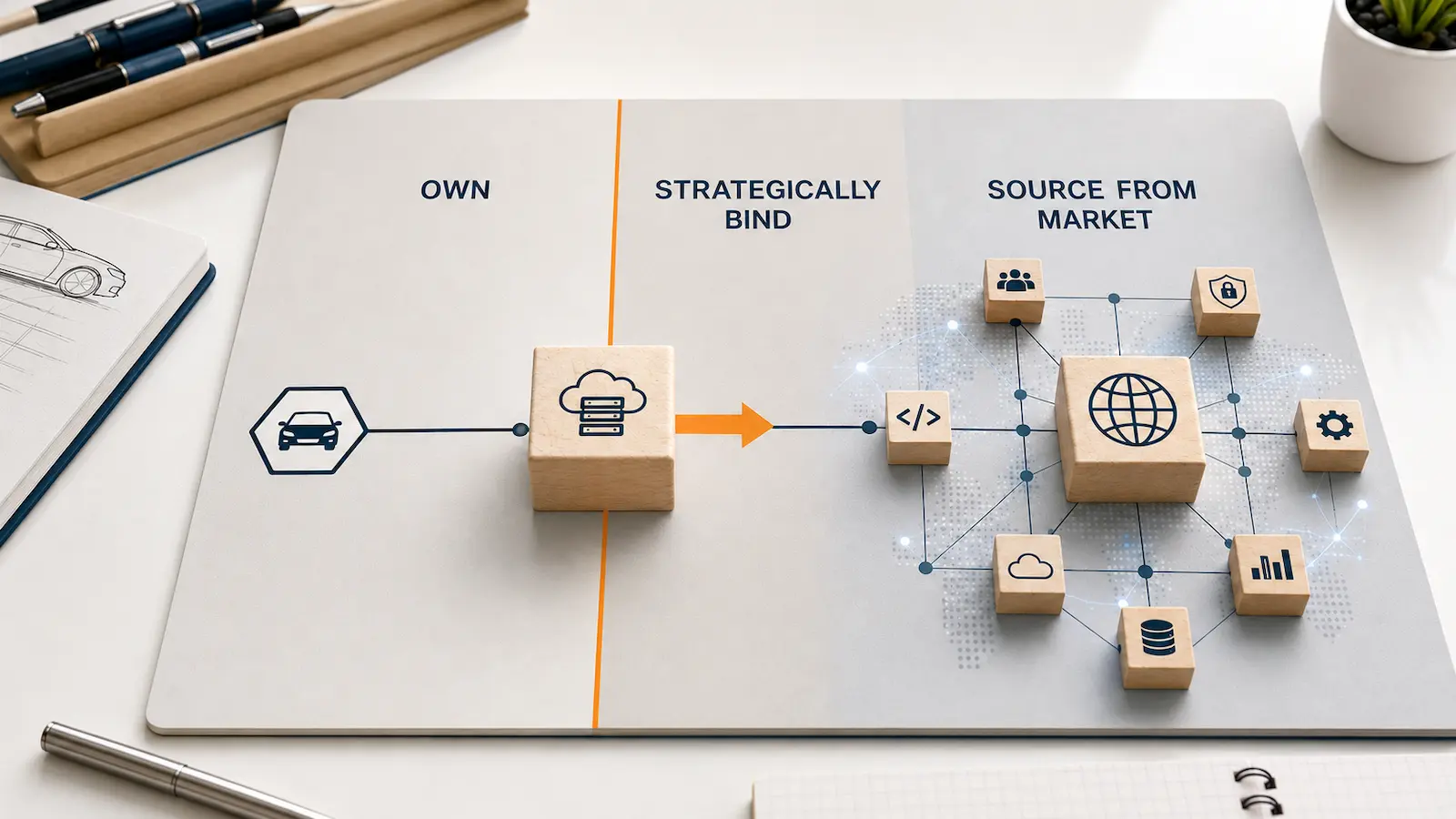
Which capabilities should we own, which should we bind through a strategic relationship, and which should remain contestable in the wider provider market?
The answer is rarely permanent. It changes with the buyer’s business situation, the capabilities that will be required, the economics of maintaining and developing them, and the relative advantages available in the provider market.
AI-native delivery may change not only how a capability is built, but also how the related services are packaged, bought and priced. If productivity increases and individual assignments become smaller, providers may face significantly lower transaction values while the marketing, sales and solutioning effort required to win each engagement remains substantial. Customer-acquisition costs can then consume a larger share of contract value, weakening the return on investments in new capabilities.
Commercial models are changing as well. Traditional time-and-materials pricing becomes harder for buyers to accept when AI-driven productivity makes effort and working hours less reliable indicators of delivered value. Alternative models may transfer more delivery, productivity and pricing risk to the provider. These changes influence not only which capabilities a Tech Buyer needs, but also whether those capabilities are best owned, secured through a strategic relationship or sourced competitively from the market.
What has been announced
According to TCS’s regulatory disclosure, its Dutch subsidiary will acquire 100% of MHP for an enterprise value of €320 million in cash, excluding customary post-closing adjustments. The transaction remains subject to regulatory approvals and was expected at announcement to close within three to four months.
MHP generated revenue of €828 million in 2023, €830 million in 2024 and €742 million in 2025. It employs around 4,500 people and combines automotive and industrial consulting with capabilities in business transformation, AI, SAP, manufacturing digitalisation, connected mobility and software-defined mobility.
The acquisition is accompanied by a five-year strategic agreement between Porsche, MHP and TCS amounting to €1.25 billion. It is intended to support the industrialisation of AI across Porsche’s engineering, manufacturing, operations, customer experience and enterprise transformation agenda. TCS also plans to establish an AI Mobility Centre of Excellence for Porsche.
The two figures describe different parts of the arrangement. The €320 million enterprise value relates to ownership of MHP. The €1.25 billion agreement relates to services delivered over five years, with its own scope, economics and delivery obligations.
Porsche says the sale supports a stronger focus on its core business. TCS says the acquisition combines MHP’s automotive and industrial expertise with its global delivery, engineering and AI capabilities. MHP is expected to retain its brand and continue operating as an independent consultancy within TCS.
These are the publicly stated facts and rationales. They do not establish that AI, or AI-driven disruption of the technology-services market, caused the sale. Nor do they establish that one ownership model is universally superior. They do, however, provide a basis for examining why Porsche’s sourcing boundary may have moved.
Sourcing decisions change when the buyer’s business conditions change
A sourcing model that made sense during one economic period may become less suitable in another.
Owning a technology and consulting provider can give a Tech Buyer direct access to expertise, close alignment with business priorities and influence over investment and talent decisions. If the provider also serves external customers, ownership may offer growth potential and wider market learning.
But ownership also means carrying investment requirements, management complexity, market risk, workforce utilisation and the responsibility to keep the provider competitive beyond the needs of the parent company. This includes continuously developing the organisation and its people: renewing skills, reshaping roles and ways of working, and leading change even where established structures and incentives create inertia. These obligations become more visible when the parent company’s economic environment changes.
They also become more visible when demand in the provider’s addressable market changes. AI-native development and AI-enabled citizen development may reduce demand for conventional implementation capacity while shifting demand towards expert-led transformation, governance, integration and assurance. An owned provider then has to renew not only its technical skills, but also its delivery model, commercial model and routes to market.
Porsche entered 2026 after a difficult financial year. Group revenue declined from €40.08 billion in 2024 to €36.27 billion in 2025. Operating profit fell from €5.64 billion to €413 million, affected by product-strategy realignment, company rescaling, battery-related expenditure and US tariffs. Porsche has described a wider programme to reduce costs, streamline management and concentrate more strongly on its core business.
These figures do not prove a direct causal link between Porsche’s performance and the MHP transaction. They show why the Tech Buyer’s context belongs in the sourcing analysis. When growth, margins and investment priorities change, ownership is assessed against a different set of constraints.
The relevant question is not whether MHP remains strategically useful. The five-year agreement indicates that its capabilities remain important. The question is whether ownership remains the most effective way for Porsche to secure and develop those capabilities under current conditions.
From ownership to strategic binding
Before the transaction, Porsche combined two forms of control. As MHP’s owner, it had corporate control over the provider. As an MHP client, it also shaped work through demand, priorities, projects and operational governance.
After closing, these mechanisms will be separated. Corporate ownership will move to TCS. Porsche will retain influence as a major strategic client through the five-year agreement, commercial commitments, governance structures and the importance of the relationship to all three parties.
This is not a simple move from “internal” to “external”: MHP already served hundreds of clients outside Porsche. Nor is it a conventional competitive outsourcing exercise in which an incumbent is replaced after a market-wide selection.
It is better understood as a change in the sourcing boundary:
- Ownership becomes a strategic provider relationship. Porsche gives up shareholder control but secures continued access to MHP and TCS through a long-term agreement.
- A captive advantage becomes a provider-scale advantage. MHP’s automotive and Porsche knowledge will be combined with TCS’s much larger client base, talent system, technology investments and global delivery capabilities.
- Investment responsibility moves. TCS becomes responsible for developing MHP as a competitive consulting and technology business across multiple clients and markets.
- Continuity is protected contractually. Porsche and MHP intend to continue their long-standing collaboration, particularly in digital transformation and AI.
- Dependency changes rather than disappears. Porsche reduces ownership exposure but creates a strategically important provider dependency that must be governed accordingly.
This distinction is central to Buyer Sourcing Decisions. A company does not choose only between building a capability internally and buying isolated external services. It can own a provider, operate a captive or shared-service organisation, establish a strategic partnership, create an extended-enterprise model, use multiple specialists or preserve competitive sourcing from the market.
Each Sourcing Model distributes investment, control, risk and flexibility differently.
AI-native delivery changes the economics of capability ownership
The AI dimension should be treated carefully. The public information does not demonstrate that AI weakened MHP or directly triggered the transaction. Porsche’s business position, its focus on the automotive core and MHP’s own revenue development all form part of the context.
At the same time, an AI-native future changes what is required to maintain and develop a competitive technology-services capability.
AI-native delivery is not created by adding a few tools to an existing operating model. Providers increasingly need to invest in engineering platforms, agentic workflows, data foundations, model evaluation, security, governance, reusable assets and new approaches to accountability. Roles and skills must evolve continuously. Successful use cases must move from isolated experiments to repeatable and governed delivery.
For an automotive company, these capabilities support the core business but are not the entire business. For a global technology-services provider, building, applying and scaling them across clients is itself a core strategic obligation.
AI-supported delivery can also change the economic unit of the service business. For many software initiatives, teams may become materially smaller and more senior. Delivery may increasingly be organised around AI pods, forward-deployed engineers or multidisciplinary expert teams: creators who combine technology expertise, business understanding and direct responsibility for outcomes rather than larger teams of conventionally specialised developers.
Smaller teams can mean smaller project and deal values even when the work remains strategically important. Buyers may also push towards fixed-price, outcome-oriented or other models that make AI productivity visible in the commercial arrangement. Providers must then recover capability investments, marketing, sales and solutioning costs across lower individual contract values while accepting more estimation and delivery risk.
This gives a much larger technology-services organisation several potential economic advantages:
- AI, engineering and governance investments can be reused across more clients and industries.
- Learning can accumulate across a wider range of implementations and operating contexts.
- Specialist talent can access more projects, career paths and technology environments.
- Capacity and reusable capabilities can potentially be redirected as demand changes across clients, sectors and regions. Skills tied to legacy technologies with declining demand can be renewed or redeployed across a broader project base.
- Domain expertise can be combined with global delivery, engineering and shared technology capabilities.
- The provider has a stronger commercial incentive to keep the capability competitive in the external market.
These advantages are not automatic. Larger scale can also introduce complexity, slower decisions, standardisation pressure and distance from the client. MHP’s domain expertise and proximity to Porsche could be diluted if integration is handled poorly. Retaining the MHP brand does not by itself guarantee the preservation of its culture, talent or decision autonomy.
The buyer therefore needs evidence that the new provider model will combine the intended strengths rather than merely place one organisation inside another. The same principle applies when evaluating how AI-native engineering changes Partner Selection.
What Porsche may gain—and what it gives up
The new arrangement potentially gives Porsche access to MHP’s established expertise together with TCS’s global AI, engineering, technology and delivery capabilities. It transfers responsibility for developing and utilising MHP as a provider to a vastly larger company whose core business is technology services and which can deploy capabilities, investments and talent across a much broader customer base. It also supports Porsche’s stated objective of concentrating more strongly on its automotive core.
But the model changes Porsche’s risk profile rather than eliminating risk.
Porsche gives up the direct control and economic participation that come with ownership. It becomes more dependent on contractual governance, relationship quality, delivery performance and TCS’s strategic priorities. The €1.25 billion agreement provides continuity and commitment, but its scale makes dependency, accountability and value realisation more important.
Relevant governance questions include:
- Which decisions remain with Porsche, and which move to MHP or TCS?
- How will critical Porsche-specific knowledge be retained and protected?
- How will MHP’s specialist identity and senior expertise be preserved?
- Which outcomes, capabilities and productivity improvements will be measured?
- How will AI-generated efficiencies be reflected in capacity, pricing and commercial models?
- How should purchasing channels and contracting adapt if projects and deal values become smaller while the solutioning effort per opportunity remains high?
- Which party carries estimation, productivity and delivery risk when time and effort no longer provide a reliable proxy for value?
- What happens when priorities, technologies or volumes change during the five-year period?
- Which capabilities must remain transferable or contestable?
- What rights, assets and knowledge would Porsche need if the relationship had to be reconfigured later?
A long-term strategic agreement can provide stability during a major transition. It should not be treated as a substitute for governance or reversibility.
A sourcing-boundary review for Tech Buyers
The MHP–TCS transaction is unusual in scale and structure, but its underlying decision is relevant to many organisations. Business conditions and technology economics can change faster than an established sourcing model. The same review is relevant to service providers reconsidering their delivery and commercial models, and to investors assessing the durability of provider capabilities and earnings.
Tech Buyers can review their own sourcing boundary through seven questions.
1. Has the business context changed?
Changes in growth, margins, capital priorities, regulation, market demand or strategic focus may alter what the organisation can and should own. A model that was attractive during expansion may impose different trade-offs during restructuring or margin pressure.
2. Is the capability itself still strategically important?
Divesting a capability owner does not necessarily mean the capability has become unimportant. Separate the importance of the capability from the preferred model for accessing it.
AI can also change the accessibility of the capability itself. Business knowledge and operating logic are increasingly embedded in and documented through business systems, data and workflows. AI can make this accumulated context more analysable and reusable. Legacy modernisation, for example, may become more feasible when AI can help reconstruct architectural dependencies, business rules and undocumented complexity. The capability may remain strategic even while the economics and organisational model for applying it change.
3. Does ownership create a distinctive advantage?
Ownership may be justified when it provides differentiated intellectual property, privileged access to scarce talent, essential control, regulatory assurance or unusually tight integration with the business. If the same outcomes can be secured through governance and contractual rights, ownership may be less necessary.
4. Who can renew and scale the capability more effectively?
A specialised provider may be able to spread technology investments, reusable delivery assets, talent development and learning across a larger customer base. An internal organisation may retain stronger context, faster alignment and clearer accountability. The relevant comparison is specific to the sourcing need.
5. Where can talent be used and developed most effectively?
Capability ownership includes workforce economics. Consider project variety, skill renewal, utilisation, career paths and the ability to redirect talent when demand changes. A larger provider organisation may offer more flexibility, but it may also move scarce expertise towards other clients. The comparison must also account for collaboration fit: cultural expectations, communication styles, language and professional mindsets can determine whether a technically strong expert team works effectively across the organisational boundary.
6. Which form of control is actually required?
Corporate ownership is one form of control. Architecture authority, data rights, governance forums, outcome commitments, knowledge-retention mechanisms, auditability and exit provisions are others. Identify the required control before choosing the organisational model.
7. What dependency replaces the risk being removed?
Moving from ownership to a strategic provider relationship transfers investment and market risk, but it can increase concentration, lock-in and transition risk. Evaluate the new model not only for efficiency and capability access, but also for adaptability and reversibility.
Own, strategically bind or source from the market?
The three broad options are not mutually exclusive across the whole technology estate.
Own the capability where it provides material differentiation, requires direct authority, contains business-critical knowledge or cannot be governed adequately across an organisational boundary.
Strategically bind the capability where long-term access, joint investment and close integration are important, but a specialised provider has stronger scale, talent or technology economics. This model requires mature governance and deliberate management of dependency.
Source competitively from the market where requirements can be specified, several credible providers exist, switching remains feasible and contestability creates meaningful value. This option depends on trustworthy, comparable information about specialist providers beyond the small group of established strategic vendors; otherwise, identifying, evaluating and managing providers across the long tail of the market requires disproportionate buyer effort.
Many effective sourcing strategies combine all three. The task is not to defend the existing boundary. It is to determine whether each capability still sits on the right side of it.
The broader lesson from the MHP–TCS deal
The transaction is not proof that every corporate technology subsidiary should be sold, that global providers are inherently better owners or that AI makes internal capability obsolete.
Its value as a case lies elsewhere.
Porsche still needs MHP’s expertise. It is securing that expertise through a different model because the business context, investment logic and provider opportunity have changed. TCS is acquiring domain depth, local market position and an anchor-client relationship. MHP gains access to a much broader customer base, talent system, investment capacity and global delivery organisation while carrying the challenge of preserving the strengths that made it valuable.
For Tech Buyers, the lesson is that sourcing architecture should be reviewed as deliberately as technology architecture. For service providers, the same case raises a business-model question: which expertise, delivery units, sales motions and commercial models remain viable as the size and economics of individual engagements change?
Business pressure can change the affordability of ownership. AI-native delivery can change the investment required to keep a capability competitive. The economic half-life of technical expertise is shortening as technologies and delivery methods evolve faster, increasing the cost of continuous renewal. At the same time, providers may need to recover those investments from smaller individual engagements. Provider scale can change where talent, shared technology capabilities and learning can be deployed most effectively. None of these factors determines the answer alone.
The decision is whether ownership, strategic binding or market sourcing provides the best combination of capability, control, economics and adaptability under the organisation’s current conditions.
That is the sourcing boundary Porsche is now redrawing.
Frequently asked questions
Why is Porsche described as the Tech Buyer when it is selling MHP?
In the M&A transaction, Porsche is the seller and TCS is the acquirer. In the sourcing relationship, Porsche is a buyer and user of technology, consulting and transformation services. Porsche is selling a provider it owns while continuing to secure that provider’s capabilities through a strategic agreement.
Does the sale show that AI has reduced the need for MHP?
No. The five-year agreement and planned AI Mobility Centre of Excellence indicate continued demand for MHP and TCS capabilities. AI is better understood as one factor changing the investment and scale required to develop those capabilities, not as evidence that they are no longer needed.
It may nevertheless shorten the economic life of some existing expertise and increase the investment required to keep a provider competitive. That can make it rational to change ownership and investment responsibility while the business and its capabilities are still strategically valuable. The public information does not establish that this was Porsche’s motivation, but it is a relevant consideration when interpreting the wider market context.
What is a sourcing boundary?
The sourcing boundary defines which capabilities an organisation owns and operates internally, which it accesses through strategic partners, and which it obtains competitively from the wider market. It depends on business context, strategic importance, control requirements, capability economics and available provider options.
When should a Tech Buyer reconsider an established sourcing model?
A review is useful when business performance, strategic priorities, technology requirements, provider economics or dependency risks change materially. It is also warranted when the service-delivery model itself changes: for example, when AI-native development enables much smaller expert teams, when shared centres of excellence serve many initiatives with continuously renewed knowledge, or when commercial models move away from effort-based pricing. The objective is not automatically to outsource or insource, but to test whether the current model still provides the required capability, control, value and adaptability.
What should buyers review when a strategic provider is acquired?
Reassess ownership incentives, leadership continuity, talent retention, delivery responsibilities, governance, commercial commitments, knowledge protection and exit options. A familiar provider name may remain while the organisation behind it and its strategic priorities change substantially.
ValueLeap perspective
ValueLeap supports Tech Buyers in reviewing sourcing strategy, comparing Sourcing Models, evaluating how AI-native engineering changes Partner Selection and validating whether an existing or proposed provider setup still fits the organisation’s business conditions.
If your sourcing boundary, strategic provider relationship or operating model needs a second opinion, discuss the decision with ValueLeap.
Sources and factual basis
Apply this insight to your sourcing decision.
Use the related guidance to translate this issue into relevant criteria, a sourcing model or a validation step for your specific context.
