


What Does a Software Engineering Partner Ranking Actually Rank?.
Learn what Clutch and GoodFirms rankings measure, how sponsored listings differ from organic scores, and what CTOs should validate before selecting a partner.


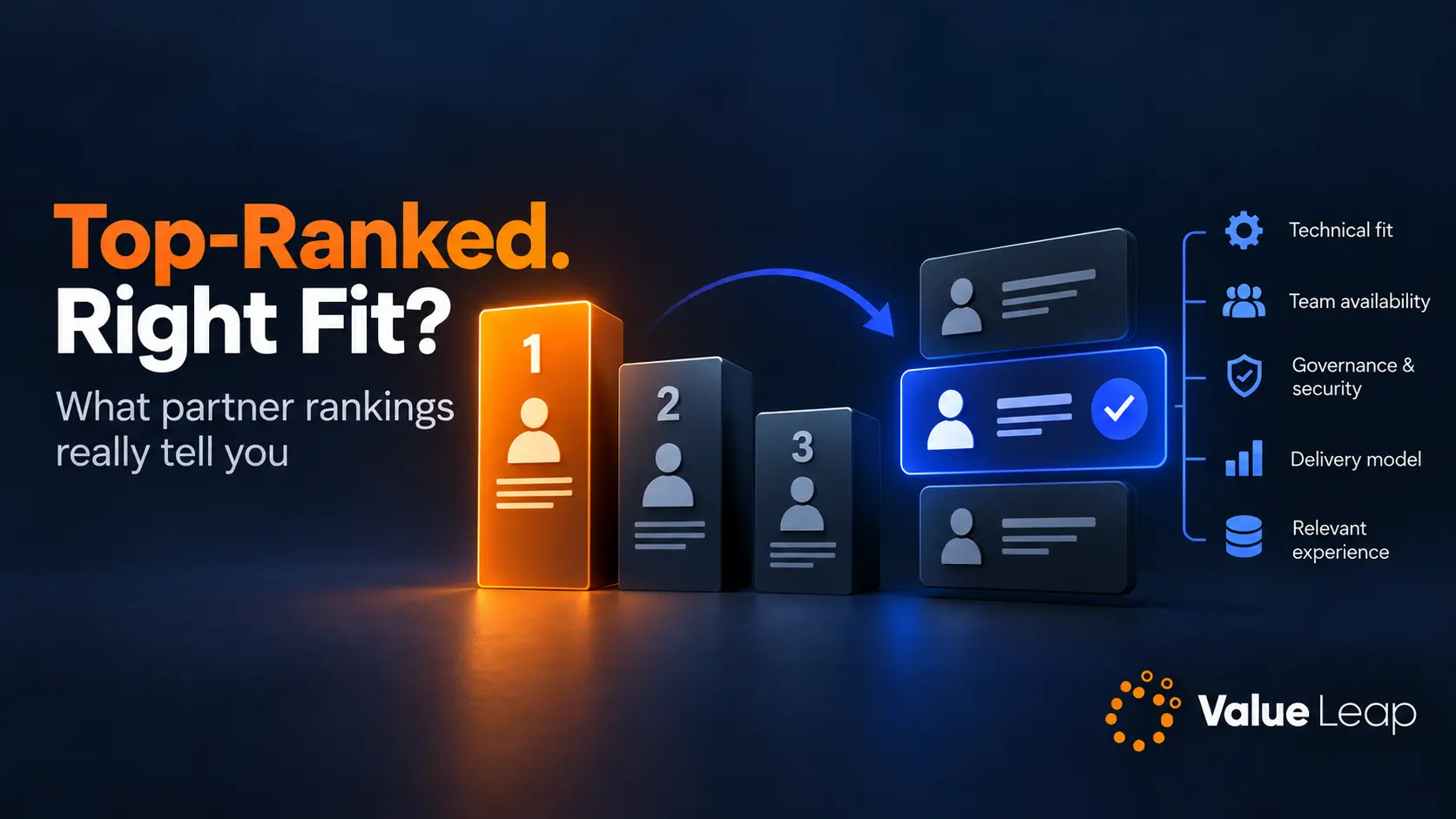
Why a top position on a provider list can be useful — and why it may tell you less than you think about the right partner for your project.
A top-ranked provider. But top-ranked for what?
Search for a software engineering partner and you'll find plenty of lists promising to identify the best development companies.
Some rank providers by service category. Others emphasise client reviews, industry expertise or market presence. A company may appear near the top of one list, further down another, and not at all in a third.
That doesn't necessarily mean one platform is right and the others are wrong.
They may simply be measuring different things.
For a CTO, Head of Engineering or sourcing professional, understanding those differences is often more useful than knowing which company occupies first place.
What goes into a provider ranking?
Most ranking methodologies combine several indicators. Depending on the platform, these may include:
- Client reviews: Feedback from customers about their experience with a provider.
- Delivery experience: Previous projects, client portfolios and documented work.
- Specialisation: The proportion of a provider's business focused on particular services, technologies or industries.
- Market presence: Visibility, reputation, awards and other indicators of an established business.
- Provider information: Profile details, service descriptions and supporting documentation.
- Editorial or methodological assessment: Additional criteria defined by the platform.
There are reasonable arguments for including each of these factors.
Client reviews help buyers understand how a provider has worked with others. Documented projects offer insight into experience. Specialisation can distinguish a focused engineering firm from a broader IT services company.
The difficulty comes when different signals are compressed into a single position on a list.
A highly ranked provider may have an excellent record of delivering web applications for mid-sized businesses. That doesn't establish whether it can support a regulated enterprise's legacy modernisation programme or provide an experienced embedded engineering team.
Its ranking may be entirely justified. The buyer's requirements are simply more specific than the ranking.
Two platforms, different approaches
Clutch and GoodFirms are useful examples because both publish information about their ranking methodologies.
Clutch: demonstrated capability and service focus
Clutch evaluates providers using factors such as verified client reviews, previous client work, market presence and service specialisation.
Its Clutch Rank and Leaders' Matrices serve related but different purposes.
Clutch Rank positions providers within a particular directory category. The Leaders' Matrix provides an additional perspective by plotting providers according to their service focus and evidence of delivery capability.
A company can therefore rank differently across categories. A strong position in mobile application development does not necessarily translate into the same position in cloud engineering.
There is also an important distinction between the underlying ranking and what visitors initially see on a directory page.
Clutch offers sponsored placements, and its default directory order also takes provider verification status into account. Sponsored providers appear first, followed by Premier Verified and Verified providers. Other eligible providers are then ordered by Clutch Rank.
Importantly, Clutch states that sponsorship does not change a provider's underlying Clutch Rank score or its organic Leaders' Matrix position.
For buyers, this means that the first company displayed in a directory is not necessarily the highest-ranked provider according to the underlying evaluation methodology.
GoodFirms: competencies and performance
GoodFirms takes a different approach through its Leaders Matrix.
Its published methodology evaluates companies along two dimensions: Core Competencies and a broader 360-Performance View. These combine information about service specialisation with indicators of execution and performance.
GoodFirms also describes eligibility requirements for ranking and states that sponsored placements are excluded from the algorithmic scores.
That distinction matters for the same reason it does on Clutch: commercial visibility and methodological evaluation should not be confused.
Both platforms offer structured ways to make a large provider market easier to navigate. Their methodologies also demonstrate why the word ranking needs context.
Before relying on any result, a buyer should understand what was measured, which companies were eligible and how the information was presented.
Five questions worth asking about any ranking
You don't need to reverse-engineer an entire ranking algorithm. But a few questions can make the results much more useful.
1. Which companies could appear in the ranking?
Every ranking starts with a defined provider universe.
It may cover a particular service category, geography, company size or platform membership. Some providers may need to register, supply information or meet minimum eligibility requirements.
A company that is absent from a list has not necessarily been assessed and rejected. It may simply fall outside that list's scope.
2. What does a high position actually indicate?
A ranking might reward a strong history of customer satisfaction, an extensive project portfolio, clear specialisation or broader market visibility.
These are useful characteristics, but they are not interchangeable.
A provider recognised for its track record may still lack the specific team, delivery model or technical experience required for a new engagement.
3. Where does the evidence come from?
Reviews, case studies, certifications and references answer different questions.
A client review describes someone's experience of working with a provider. A case study offers information about work undertaken and, where documented, its results. A certification establishes compliance with defined requirements within a particular scope.
Understanding who supplied the information, what was checked and how recently it was updated helps buyers judge how far they can rely on it.
4. Does the displayed order reflect the evaluation?
A directory may combine organic rankings with sponsored listings, featured profiles or alternative sorting options.
These arrangements are not inherently problematic. Advertising and evaluation can coexist.
What matters is that buyers can distinguish paid visibility from the criteria used to assess providers.
5. What does the ranking leave unanswered?
This is often the most important question.
A ranking might establish that a company has relevant experience and positive customer feedback. It may tell you little about the engineering team available for your project, how responsibilities would be divided, whether the delivery model fits your organisation or how the provider would handle your security and governance requirements.
Those questions usually require further evaluation.
The same ranking can lead to different decisions
Imagine two organisations considering a provider with a strong ranking and an impressive portfolio.
The first is a scaleup building a new digital product. Its internal engineering team is small, requirements are changing quickly, and it needs a partner that can contribute with limited supervision.
The second is an established financial services company. It wants to extend an existing engineering organisation, maintain architectural consistency and work within defined security and governance processes.
Both may value the provider's positive client reviews and successful projects.
But the scaleup will probably pay closer attention to onboarding speed, product experience, seniority and ownership. The enterprise may place greater weight on governance, architectural alignment, security controls and integration into established delivery processes.
Neither is applying the wrong criteria.
They are making different sourcing decisions.
This is where a provider ranking reaches its natural limit. It can offer valuable signals about a company, but it cannot establish suitability without knowing the buyer's requirements.
Turning a ranking into a useful shortlist
Rankings are often a sensible starting point for market research, particularly when a buyer is unfamiliar with the available providers.
The next step is to move from general market recognition towards engagement-specific evaluation.
At ValueLeap, we use a structured selection sequence:
Sourcing Need → Eligibility → Relevant Fit → Evidence → Decision
Sourcing Need: Clarify what the organisation wants to achieve, the capabilities required and the operating model that makes sense.
Eligibility: Identify the non-negotiable requirements a potential partner must meet.
Relevant Fit: Assess how closely each eligible provider matches the technical, organisational and delivery requirements.
Evidence: Examine what supports the provider's claims, including the relevance of previous experience and any unanswered questions.
Decision: Compare the remaining candidates, their proposed approaches and the risks or assumptions that still need attention.
A provider's position in a ranking can inform several of these steps. It should not replace them.
Where TransparencyWins and ValueLeap fit
There are different ways to approach software engineering partner selection. Some buyers prefer to conduct their own research. Others need help defining requirements, challenging a shortlist or managing a more complex evaluation.
TransparencyWins supports independent provider research by making structured company information, capabilities and supporting evidence available for examination and comparison.
Buyers can use that information to explore potential partners and investigate the claims that matter to their sourcing needs.
ValueLeap provides selection advisory support. We bring sourcing experience, market knowledge and a structured assessment approach to help buyers identify relevant candidates, examine the available evidence and work towards a partner decision.
The two offerings have different roles. TransparencyWins can be used independently, while ValueLeap can support the evaluation of providers identified through TransparencyWins or other sources.
The aim is to give buyers a clearer basis for their decision, whether they are starting with a broad market search or already have a shortlist.
What should buyers take away?
A ranking is most useful when you know what it measures.
Strong reviews, recognised expertise and documented delivery experience all deserve attention. They can help identify promising candidates and reduce the work involved in searching a large market.
But a high position on a general provider list is not the same as a demonstrated fit for your own engagement.
Before moving a ranked provider onto your shortlist, ask what the ranking has established — and what you still need to check.
Explore your next step
Looking for potential software engineering partners?
Explore the ValueLeap Software Engineering Partner Finder for a structured approach to identifying suitable candidates.
Already working with a shortlist?
Our Software Engineering Partner Evaluation Criteria can help you identify which questions still need answers.
Sources and further reading
- Clutch — Research Methodology. Ranking criteria, Leaders' Matrices, review verification and directory sorting.
- Clutch — Sponsored and Non-Sponsored Listings. Distinction between paid directory placement and organic ranking.
- GoodFirms — Research Methodology. Leaders Matrix, evaluation criteria, eligibility requirements and treatment of sponsorship.
Platform methodologies reviewed in October 2026. Features, criteria and commercial arrangements may change.
