


Is Your Software Engineering Partner AI-Ready? 7 Questions to Ask.
Seven questions to assess how software engineering partners adapt AI practices, delivery models and commercial offerings to benefit clients.


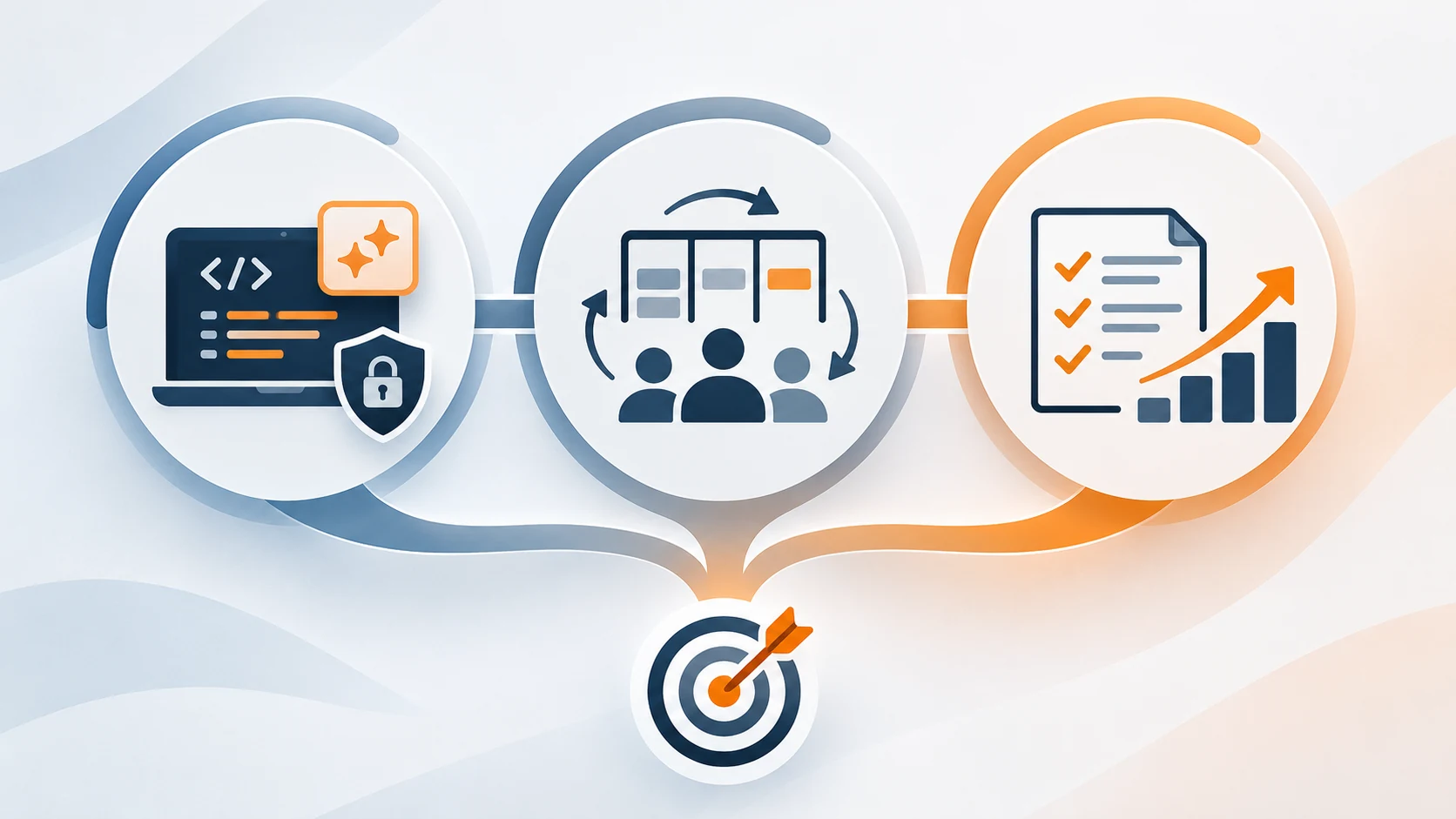
Using AI tools does not automatically make a Software Engineering Partner AI-ready. What matters is how the provider has adapted its engineering practices, delivery model and commercial offering — and what tangible benefits these changes bring to clients.
Generative AI is changing how software is developed. Code can be produced faster, prototyping is becoming more accessible, and ideas that previously required substantial initial investment may become easier to explore.
For Tech Buyers, however, the important question is no longer simply how fast individual developers can work.
Has the Software Engineering Partner changed what it offers and how it delivers — or is it essentially operating as before, with additional tools?
This distinction matters when companies reassess their external engineering needs, review existing providers or build a shortlist. The focus is not on defining AI-native engineering in general, but on evaluating what a particular provider has actually changed.
Faster coding does not automatically mean better delivery
There is growing evidence that AI affects software development. Yet the scale and direction of productivity improvements depend on the work, the team and the environment.
Google Cloud's 2025 DORA report identified a positive relationship between AI adoption and software delivery throughput, alongside a negative relationship with delivery stability. The report emphasised the importance of effective workflows, testing and feedback mechanisms.
A 2026 study by Demirer, Musolff and Yang found that substantial increases in coding activity translate into much smaller gains in released software. Code review, integration, testing and release processes remain important constraints.
A controlled 2025 METR experiment found that experienced open-source developers took longer to complete the particular tasks studied when using the AI tools available at that time. A 2026 follow-up suggested possible improvements but could not reliably quantify the newer productivity effect.
These findings are not necessarily contradictory. They examine different environments, tools, activities and outcomes.
For Partner Evaluation, the implication is clear: A productivity claim is only useful when the buyer understands what was measured and how the benefit reaches the delivery outcome.
The division of work between client and partner may change
Companies can increasingly run experiments, develop prototypes and undertake some engineering tasks themselves.
As a result, the point at which external expertise becomes necessary may shift.
A company that has created an AI-assisted prototype might not need an external team to start again from scratch. It may instead require:
- independent architecture and technical risk assessment;
- security, data protection and compliance validation;
- integration with existing systems;
- robust testing and quality assurance;
- support for production readiness and operations;
- specialist engineering capabilities that are unavailable internally.
External contributions may become more focused. In other situations, a comprehensive, long-term delivery team will remain the better option.
The question is not which model will replace the other. It is whether the partner can adapt its contribution to the actual Sourcing Need.
Three dimensions of meaningful provider adaptation
A provider may adopt AI tools without materially changing its delivery or business model. Tech Buyers should therefore examine three distinct dimensions.
1. Tool Adoption: How does the partner use AI?
This is about engineering practice.
Which activities are AI-assisted? How are outputs reviewed? What safeguards exist for confidential information, intellectual property, security and AI-generated code?
Using current tools can be a useful signal. On its own, however, it is not evidence of better delivery.
Buyers need to understand how the provider maintains quality, traceability and accountability.
2. Delivery Adaptation: What has changed in the way the partner works with clients?
This is where changes become more visible to the customer.
Can the provider start with a client-developed prototype rather than requiring a complete redevelopment process? Can it offer smaller, more senior teams or focused specialists? Can it combine discovery, engineering, validation and handover in a way that fits the engagement?
Some tasks may justify shorter projects. Other requirements may lead to new forms of continuous collaboration, such as application modernisation, integration or a portfolio of smaller initiatives.
In either case, roles, technical governance, collaboration and responsibility boundaries need to be clear.
One particularly important question is who accepts responsibility for the quality, security and further development of code that the client has already created, including AI-assisted code, and under what conditions.
3. Commercial Adaptation: What benefits does the client receive?
The third dimension concerns business value.
When particular engineering activities require less effort, the benefit does not necessarily have to appear as a lower hourly rate. It may take the form of shorter delivery times, reduced capacity requirements, greater scope or better quality.
But the client should be able to understand how that benefit is achieved and assessed.
This makes the engagement model part of the evaluation.
Does Time and Materials still fit, and how is improved productivity reflected in the engagement? Would a bounded scope with agreed deliverables be more appropriate? Could a hybrid or partially outcome-based model make sense? Can the provider deliver smaller assignments economically? How are changes, risks and responsibilities allocated between the parties?
No single commercial model is universally superior. A partner that has modernised its engineering practices should nevertheless be able to explain how the changes affect its offering and the value delivered to the client.
Seven questions to ask during Partner Evaluation
Tech Buyers can use the three dimensions to structure seven practical questions.
| Evaluation question | What to look for |
|---|---|
| 1. What has AI actually changed in your engineering practices? | Specific workflows, use cases, safeguards and observed results rather than a tool list |
| 2. How do you measure its impact on end-to-end delivery? | Lead time, quality, rework, release readiness and suitable baselines — not just code output |
| 3. How do you work with software the client has already developed? | Assessment, acceptance, integration and clearly agreed responsibility boundaries |
| 4. What team and engagement models do you now offer? | Flexible team sizes, specialist contributions, appropriate seniority and collaboration |
| 5. How do you manage quality, security and governance in AI-assisted development? | Testing, review, traceability, data and IP protection, clear ownership |
| 6. How do your clients benefit commercially from these changes? | Transparency about effort, speed, scope, quality and the commercial arrangement |
| 7. What evidence supports your claims? | Comparable engagements, verifiable outcomes, references and examples of changed delivery practices |
The answers must be evaluated against the actual Sourcing Need.
A convincing example involving a small AI-assisted product does not automatically prove capability for a complex, regulated platform transformation.
Likewise, a newly announced service offering is initially a claim. Relevant delivery experience, documented results or other appropriate validation is needed to establish stronger evidence.
Two providers, two possible approaches
Consider a company that has developed an AI-assisted prototype internally. It now needs to turn it into a secure, maintainable service integrated with existing systems.
Provider A proposes a comprehensive engineering team that will largely rebuild the solution following a conventional discovery phase.
Provider B proposes a bounded architecture, security and production-readiness assessment, followed by a small team to address the necessary integration, engineering and testing tasks.
For this starting point, Provider B might be a better fit — provided the assessment is sound and architecture, code quality, security risks, IP rights, testing, acceptance criteria and the transfer of responsibilities are clearly addressed.
For a large, multi-year platform modernisation, Provider A's broader model could be more appropriate.
The relevant distinction is not which provider sounds more innovative. It is which contribution creates greater value in the specific context.
Provider economics may need to change as well
The shift also creates challenges for Software Engineering Providers.
If some engagements become smaller or shorter, business development, proposal preparation, onboarding and account management may account for a larger proportion of the contract value.
A provider designed mainly for large team engagements cannot necessarily apply the same cost structure to a much larger number of small assignments.
Possible responses include clearly defined assessment services, reusable delivery methods, more efficient proposal processes, continuous client relationships and combinations of advisory and engineering services.
At the same time, lower implementation costs may make additional software initiatives economically viable, creating new demand.
Both developments are plausible. Neither a universal decline in external engineering services nor automatic growth for providers has been established.
For Tech Buyers, the practical consideration is whether the provider's business model can support the collaboration they need.
What does this mean for Software Engineering Partner Selection?
Evaluating an AI-ready Engineering Partner should not begin with a list of AI products the provider uses.
It should begin with the client's own requirements:
What can and should we deliver internally? Which external capabilities, delivery resources and responsibilities do we still need?
These answers define the evaluation criteria. The seven questions then help buyers distinguish claimed AI maturity from meaningful client benefits, suitable delivery models and credible evidence. The broader Software Engineering Partner Evaluation Criteria provide further context.
ValueLeap helps Tech Buyers structure their Sourcing Needs, identify relevant Software Engineering Partners and evaluate differences in capabilities, delivery approach and commercial fit.
Conclusion
AI can make software development more productive. That fact alone is not enough to make a better partner-selection decision.
A Software Engineering Partner should be able to show how its working practices have changed, how it collaborates with increasingly capable client teams and what operational and commercial benefits result.
The central question is:
What has this partner changed about the way it works and what it offers because of AI — and what concrete benefit does that bring us?
Evaluating how your engineering partners are adapting to AI? ValueLeap can help you assess their capabilities, delivery models and commercial fit against your specific Sourcing Need. Discuss partner selection.
Related ValueLeap Insights
- How AI-Native Engineering Changes Partner Selection
- Three Ways Software Engineering Providers Become AI-Native
- Software Engineering Sourcing Insights
Research references
- Google Cloud, 2025 DORA Report, September 2025.
- Demirer, Musolff and Yang, Writing Code vs. Shipping Code, NBER Working Paper, May 2026, revised September 2026.
- METR, Early-2025 Developer Productivity Experiment, 2025, and February 2026 update.
