


Three Ways Software Engineering Providers Become AI-Native — and What Tech Buyers Should Validate.
This Insight examines three provider transformation paths to AI-native software engineering — established-provider transformation, M&A-led capability platforms and AI-native challengers — and what Tech Buyers should validate in each model.


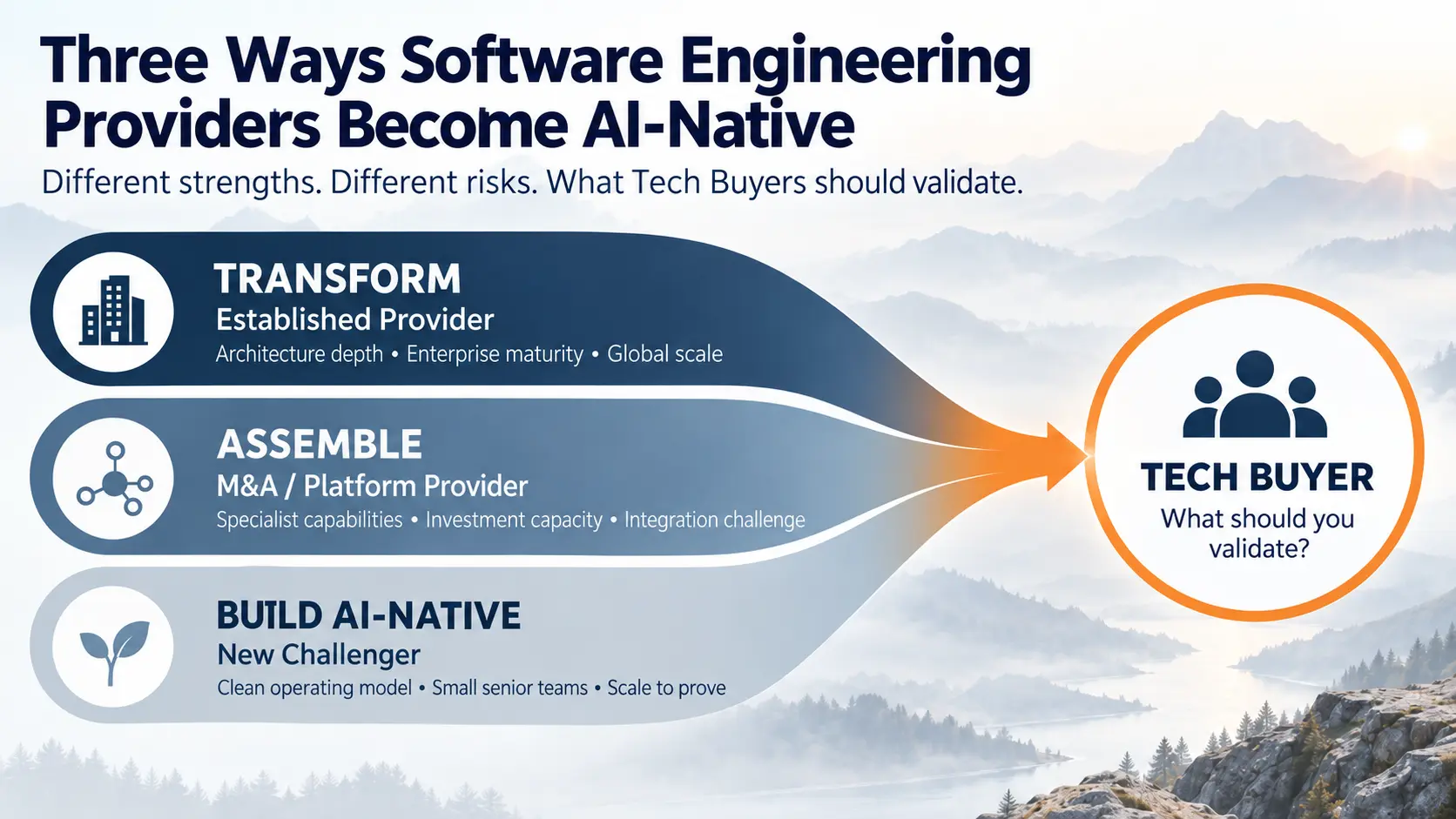
The next generation of AI-native Software Engineering Partners may not emerge from one provider archetype.
Some established providers will transform their existing delivery organisations. Others will assemble new capability platforms through acquisitions. New challengers will build AI-native operating models from the ground up.
For Tech Buyers, the relevant question is not which path is inherently better. It is which operating model fits the Sourcing Need — and what evidence shows that the provider can deliver reliably within it.
This builds on a broader shift described in our earlier Insight on how AI-native engineering changes what Tech Buyers need from Software Engineering Partners. As implementation becomes easier to automate, Partner value can move toward architecture, context, verification, governance and responsibility.
Three paths are emerging
There are at least three plausible paths through which the next generation of Software Engineering Partners can develop:
- Transform an established Software Engineering Provider.
- Assemble a broader provider platform through acquisitions and M&A.
- Build AI-native from the ground up.
Each path starts with different structural strengths. Each also creates a different buyer risk.
1. Transform an established Software Engineering Provider
Established providers can enter the AI-native era with advantages that are difficult to recreate quickly.
They may bring:
- deep architecture knowledge;
- experience across existing enterprise platforms and technology generations;
- strong capabilities in Legacy Modernization, Systems Integration, Platform Transformation and migration;
- accumulated understanding of operational dependencies and constraints;
- mature delivery governance, Security and Compliance;
- customer relationships and reference projects;
- technology-partner relationships, structured training and certification programmes;
- global delivery and experience coordinating complex multi-vendor environments.
For larger enterprises, these factors can matter significantly. A provider that already understands complex estates, regulated environments, procurement expectations and global operating models may reduce risks that have little to do with code generation itself.
But enterprise readiness is not the same as AI-native capability.
The core challenge is transition.
AI-enabled delivery can require a provider to redesign its delivery model, skill pyramid, recruitment profile, organisation and commercial model. Some work that previously required large implementation-heavy teams may be delivered by smaller, more experienced groups supported by AI agents and automation.
That can create structural pressure. Demand may decline for parts of the traditional skill base while bench volumes and utilisation pressure rise. Sales organisations may then have a strong incentive to keep existing capacity deployed.
Buyer diagnostic: Is the provider redesigning its delivery model around future demand — or mainly using AI to preserve utilisation of the existing model?
We call this the AI Transition Trap: a useful buyer diagnostic, not a prediction that incumbents cannot adapt. The same tension sits behind the Innovator’s Dilemma in Software Engineering Services: a provider can adopt the technology while preserving the economics and organisation of the old delivery model.
2. Assemble a provider platform through acquisitions
A second path is to acquire specialist companies and assemble them into a broader provider platform.
This can provide relatively fast access to:
- AI Engineering;
- Cloud and Data capability;
- Cybersecurity;
- Product Engineering;
- industry and domain expertise;
- specialist talent and reusable IP;
- new geographies and customer relationships;
- greater investment capacity for engineering platforms, governance and AI enablement.
The attraction is clear: instead of waiting for one organisation to develop every capability organically, an investor or larger provider can combine specialist businesses that already have them.
The main challenge is integration.
Acquisition does not automatically create a coherent delivery system. Separate firms can share ownership while continuing to use different engineering practices, incentives, platforms, governance models and commercial structures.
Tech Buyers should therefore ask:
- Is there genuinely one operating and delivery model, or mainly one ownership structure?
- Can the acquired companies work together effectively in one engagement?
- Are Architecture, Security and AI Governance consistent across the platform?
- Who owns the final outcome when several specialist entities contribute?
- Are the claimed synergies visible in customer delivery, not only in the investment thesis?
A provider can become larger without becoming more integrated.
3. Build an AI-native challenger from the ground up
A new challenger has a different structural advantage: there is no legacy delivery model or existing workforce pyramid to transition.
It can design from day one:
- roles and seniority mix;
- engineering environments and AI workflows;
- Context Management and agent orchestration;
- quality and verification responsibilities;
- commercial models;
- organisational economics.
A likely pattern is a smaller, senior, multidisciplinary team combining Business Analysis, Architecture, senior Engineering, Security, Cybersecurity, Domain Expertise, AI Engineering and responsibility for verification.
Such a provider does not need to reskill thousands of employees, protect utilisation of a traditional staffing pyramid or absorb the same bench pressure when demand shifts away from implementation-heavy work.
But absence of legacy does not mean absence of risk.
The core challenge is proof and scale.
Tech Buyers should validate:
- Enterprise Governance;
- Security and Compliance;
- Operational Resilience;
- delivery beyond the founding team;
- ability to scale without losing quality;
- continuity of specialist talent;
- transparent AI controls;
- repeatability across projects;
- credible customer references.
Buyer diagnostic: Has the company merely been founded recently — or has it built a repeatable, governable AI-native engineering system?
The engineering role itself is changing
The transition is not simply that developers use better AI tools.
It increasingly changes the engineering task from producing every line of code directly toward orchestrating, constraining and validating AI-generated engineering work.
A strong engineer increasingly needs to ensure that AI agents:
- receive the relevant business, architecture and technical context;
- understand requirements and system constraints;
- follow Architecture, Security and Coding Standards;
- do not optimise for an easy shortcut that violates the intended outcome;
- are systematically tested and reviewed;
- produce changes that can be explained, verified and owned.
AI systems can generate convincing output when important context is missing. The engineering challenge therefore increasingly becomes one of context, orchestration, constraints, verification and accountability.
A strong engineer increasingly becomes not only a creator of software, but also an orchestrator and verifier of AI-generated engineering work.
This is consistent with recent DORA research. Its 2026 qualitative analysis of enterprise software engineers found that time saved in initial code generation was often reallocated to auditing and verification, while DORA continues to describe AI as an amplifier of the underlying engineering system rather than an automatic replacement for strong practices. Read the DORA analysis.
The same pattern is visible in tooling. GitHub now allows organisations to bring internal standards, tools and contextual systems into Copilot code review through agent skills and MCP connections. This is another indication that reliable AI-assisted engineering depends increasingly on supplying the right context and controls, not merely on generating more code. See the GitHub update.
Architecture and Engineering Experience may therefore become more, not less, important when implementation becomes easier to automate.
From an engineering pyramid to smaller senior teams?
AI-native delivery may move some engagements away from a traditional implementation-heavy engineering pyramid toward smaller, senior, multidisciplinary teams.
Human judgement becomes concentrated around the parts of delivery that remain difficult to automate:
understanding intent → defining architecture → providing context → setting constraints → supervising execution → validating results → taking responsibility for the outcome
This should not be reduced to “AI replaces engineers”. A more useful buyer interpretation is that AI may reduce the amount of implementation capacity required for some engagements while increasing the importance of seniority, architecture, domain understanding, Security and orchestration skills.
Three models, three primary buyer challenges
| Provider path | Structural strengths | Primary buyer challenge |
|---|---|---|
| Established incumbent | Enterprise experience, Architecture knowledge, global scale, ecosystem relationships | Transition: has the delivery model genuinely changed? |
| M&A / assembled platform | Specialist capabilities, investment capacity, broader portfolio | Integration: does one coherent operating model exist? |
| AI-native challenger | Clean organisational model, no legacy workforce constraints, small senior teams | Proof & Scale: is the model repeatable, governable and resilient? |
None of these is automatically superior.
The relevant buyer question remains:
Which operating model fits our Sourcing Need — and what evidence shows that this provider can deliver within it?
What should Tech Buyers evaluate?
The provider model itself is only a starting point. Tech Buyers still need to assess Relevant Fit and validate Claims, Signals and Evidence.
For AI-native Partner Selection, useful evaluation dimensions include:
- Contribution beyond capacity: what critical capability or responsibility does the Partner add?
- Architecture and Domain Capability: can it reason about the enterprise environment, not only produce implementation?
- AI in the Delivery System: is AI embedded in workflows, governance and verification rather than limited to developer tool adoption?
- Engineering-role change: have roles been redesigned around Context Management, orchestration and verification?
- Team structure: has the workforce model changed in ways that match AI-enabled delivery?
- Existing enterprise environments: can the provider work effectively with Legacy, integration complexity and operational constraints?
- Technology ecosystem: are vendor and platform relationships useful to the concrete engagement?
- Repeatability: can the approach work across projects and teams, not only with a few exceptional individuals?
- Engineering System fit: can the Partner operate within the Buyer’s repositories, platforms, standards and controls?
- Governance and responsibility: who validates AI-generated work and who owns the final outcome?
- Commercial Model: does the pricing model reflect the value and productivity of the delivery system? See our comparison of T&M, Fixed Price and Outcome-Oriented models.
- Structural pressures: what transition, integration, utilisation or scale risks could influence the provider’s behaviour?
Has the provider merely equipped developers with AI tools — or has it redesigned the engineering role and delivery team around AI orchestration, context, verification and responsibility?
That question helps separate AI adoption from genuine AI-native capability.
The ValueLeap Perspective
Do not select the AI story. Validate the operating model behind it.
The buyer challenge is to distinguish AI adoption from genuine AI-native capability.
A provider with sophisticated tools may still operate with the old Delivery Model. A new company may have a modern operating model but limited Enterprise Evidence. An established provider may face significant transition complexity while retaining Architecture Knowledge, ecosystem relationships and Delivery Maturity that are difficult to replicate.
The right answer therefore starts neither with the provider category nor with the AI story.
It starts with the Sourcing Need and with Evidence.
What critical contribution can this Software Engineering Partner make that our own Engineering System cannot reliably provide — and what evidence shows that it can do so repeatedly, securely and responsibly?
ValueLeap helps Tech Buyers structure, validate and govern Software Engineering Partner decisions around the required contribution, operating model, Relevant Fit and Evidence. Discuss your sourcing need.
